

← TsundereSQL

Volume two · Aimi · Plates 08–17

Off the
Clock

Instructor Field Notes

Ten collectible plates from the instructor fan-pack, annotated by the woman in them. Every margin note is a query that was executed, with the numbers it actually returned.

First edition · September 2026 · both PDF editions are A4, 24 pages · free, no account.

Aimi standing in the proof room beside a flip chart of query diagrams

Off the Clock

Volume two · Aimi

Cover card · proposal

The cover is a card.
The pages are not.


Point at the cover and the foil follows your hand: a nebula field behind the plate, one moving light band, a gold rim. It is the same treatment the instructor cards on the home page wear, dialled to half motion.

The ten plates below stay still. Each is read alongside a query, a verdict and a paragraph of reasoning, and a foil sweeping under a paragraph is a second thing asking for your eye while you are using it on the first. Motion earns a cover; it competes with a page. If your system asks for reduced motion, even the cover holds still and keeps a fixed sheen.

Before you scroll

You kept a
book of me.


Ten plates, ten margin notes. Every query was executed against DuckDB 1.5.3-r.3 on 2026-09-05 and ships beside this book as aimi-companion.sql, with the setup, the queries and the rows they returned.

You kept a book of me. I noticed. There are twenty-four pages. Ten of them are plates. I have counted them twice, which is once more than you have.

So I started one of my own. One line per plate, ten lines, written in the margin while you were busy with the queries. It is not a long book yet. You have only just started giving me material.

The queries in these margins are mine. I ran each one myself and wrote down both numbers it returned. I do not round.

Turn the page. I am already on the next one.

Aimi

Aimi in the academy uniform beside a flip chart of query diagrams, notebook under one arm

Plate 08

Proof Room Instructor

Rare

This is page four. Line one of mine says: starts at the beginning, which is rarer than you think. The chart behind me is yours. You wanted the customers who cleared 100.00 of shipped revenue. SUM in the WHERE, and the database refused you outright, which was kind of it. So you moved the whole condition into HAVING, and it stopped complaining and told you three. The answer is two. Customer 2 only clears the bar on a cancelled order worth 300.00. The question has two filters in it, not one. Shipped belongs in WHERE, which removes rows before the sum. The 100.00 belongs in HAVING, which removes groups after.

Margin note

Same filter, two clauses, two different answers

SELECT customer_id, SUM(order_total) AS revenue
FROM orders
GROUP BY customer_id
HAVING SUM(order_total) > 100
ORDER BY customer_id;
HAVING alone3 customers
WHERE + HAVING2 customers

WHERE is evaluated before grouping and cannot reference an aggregate; HAVING is evaluated after. This question needs both clauses: status = ‘shipped’ in WHERE so the cancelled row never enters the sum, and SUM(order_total) > 100 in HAVING so the group is judged after it. Customer 2 clears 100.00 only on a cancelled order of 300.00.

Executed against DuckDB 1.5.3-r.3, 2026-09-05 · companion file: aimi-companion.sql

Aimi in profile marking row pairings between two tables on a glass board

Plate 09

Profile Row Pairing

Rare

Line two, then. On the glass: every customer and their shipped orders. You put the filter in the WHERE and got two customers back, and two is a tidy number, so you believed it. Bruno has one cancelled order. Dmitri has none at all. WHERE runs after the join, so the predicate met both of them: Bruno’s cancelled row failed it, and Dmitri’s NULL-filled row failed it too. Move it into the ON and there are four. Line three: believes tidy numbers, which is not a flaw.

Margin note

Moving the filter out of the ON clause cost you two customers

SELECT c.name, COUNT(o.order_id) AS shipped_orders
FROM customers c
LEFT JOIN orders o ON o.customer_id = c.customer_id
WHERE o.status = 'shipped'
GROUP BY c.name
ORDER BY c.name;
Filter in WHERE2 rows
Filter in ON4 rows

WHERE runs after the join and judges every row it produced, not only the NULL-filled ones. Bruno’s cancelled order fails o.status = ‘shipped’ outright; Dmitri’s NULL-filled row fails it because NULL = ‘shipped’ is UNKNOWN. Both leave a report that asked for every customer. Put the predicate in the ON clause and both come back with a count of 0.

Executed against DuckDB 1.5.3-r.3, 2026-09-05 · companion file: aimi-companion.sql

Aimi turning back in a lamplit study at night, evidence wall behind her

Plate 10

After-Hours Turn

Epic

It is late where you are. I can tell from how long page six took. December, then. You asked for the month with BETWEEN two dates and got three orders and 245.00. December has four and 745.00. Order 104 was placed at 2026-12-31 23:45:10. BETWEEN includes both endpoints, so a date upper bound is midnight at the start of the 31st, and a 500.00 order fell out of the year fourteen minutes and fifty seconds before it ended. Somebody was still working at that hour. I have written down that you are too.

Margin note

A date upper bound is midnight at the start of the day

SELECT COUNT(*) AS orders, SUM(order_total) AS revenue
FROM orders
WHERE placed_at BETWEEN DATE '2026-12-01' AND DATE '2026-12-31';
BETWEEN · 3 orders245.00
Half-open · 4 orders745.00

BETWEEN includes both endpoints, so a date-valued upper bound resolves to midnight at the start of the 31st. That midnight instant is in range; anything logged later on the 31st is not. Order 104, placed at 23:45:10, is the row that vanishes.

Executed against DuckDB 1.5.3-r.3, 2026-09-05 · companion file: aimi-companion.sql
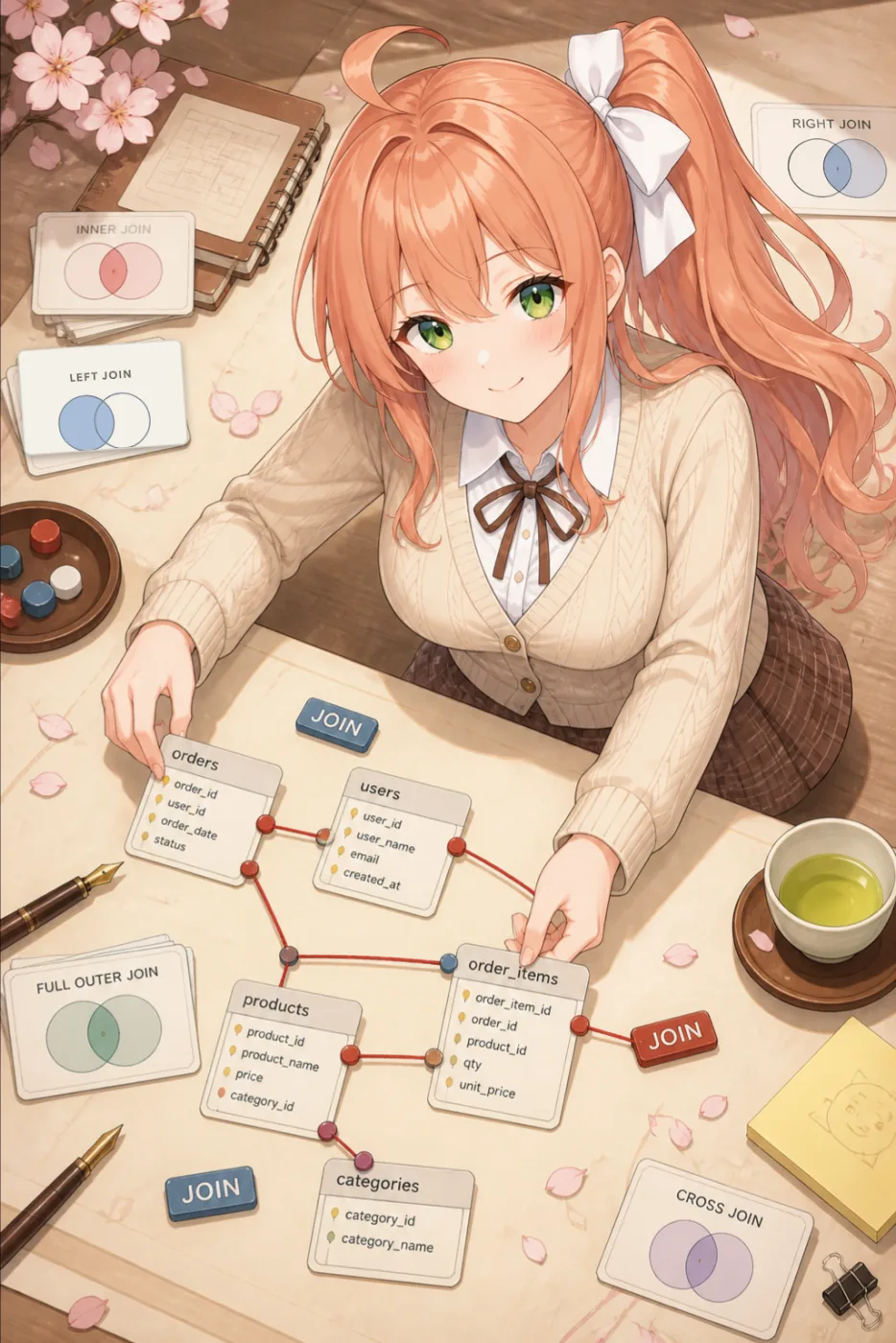
Overhead view of Aimi at a desk of join diagram cards, arranging table nodes

Plate 11

Overhead Join Table

Epic

I laid the table out before you arrived. The cards, the pens, the tea, the light. I wanted it to look like I had only just been passing. You wrote FROM orders o, customers c and left the predicate off. Not an error. A comma in the FROM is a cross join. Three customers times four orders is twelve rows and 1335.00 where the truth is four rows and 445.00. Group that by name and Aiko, Bruno and Carla each report the same 445.00. Exactly three times too much. Nobody was going to query a quarter that good.

Margin note

A missing join predicate is not an error, it is 3x

SELECT COUNT(*) AS rows_returned, SUM(o.order_total) AS revenue
FROM orders o, customers c
WHERE o.order_total > 0;
Comma join12 rows
Predicate restored4 rows

A comma in the FROM clause is a cross join, so omitting the predicate is valid SQL that multiplies the row count and every additive aggregate by the other table's cardinality. Revenue reads 1335.00 instead of 445.00, and grouped by name all three customers report 445.00 each.

Executed against DuckDB 1.5.3-r.3, 2026-09-05 · companion file: aimi-companion.sql

Aimi at an indoor pool in daylight, glancing back, a notebook held at her side

Plate 12

Poolside Turn

Epic

Your thumb is on the outer corner again. Three pages in a row. I have started marking where it lands. Counting, then. Aiko has five under COUNT(*) and two under COUNT(DISTINCT o.order_id), and both are right. One counts rows of a joined result. The other counts orders. Five is line items. Carla has no orders whatsoever and still reports one, because the join left her a row with nothing in it. You reported the five. Line six says so. I would have reported the five as well, at your age. Hold this. I am going in.

Margin note

Three counters, one query, three different numbers

SELECT c.name,
       COUNT(*)                    AS count_star,
       COUNT(o.order_id)           AS count_order_id,
       COUNT(DISTINCT o.order_id)  AS count_distinct_orders
FROM customers c
LEFT JOIN orders     o  ON o.customer_id = c.customer_id
LEFT JOIN line_items li ON li.order_id   = o.order_id
GROUP BY c.name
ORDER BY c.name;
Aiko · COUNT(*)5
Aiko · DISTINCT2

COUNT(*) counts rows of the joined result, COUNT(col) counts non-NULL values and COUNT(DISTINCT col) counts distinct ones: three grains out of one FROM clause. Aiko has 2 orders and 5 line items. Carla, who has neither, still reads 1 under COUNT(*).

Executed against DuckDB 1.5.3-r.3, 2026-09-05 · companion file: aimi-companion.sql

Aimi against a lit wall of pinned proofs at night, city window to one side

Plate 13

Proof Wall Corset

Legendary

You came back to this one. Line seven had a time on it. Now it has two. Your NOT IN is pinned up behind me, all of it, in order. You asked which customers have never ordered anything, the result came back empty, and empty felt like a pass. Aiko and Bruno are in that subquery, so their test is false. Carla and Dmitri are not, but order 204 is a guest checkout with a NULL customer id, so their test is unknown. WHERE keeps only what is true. NOT EXISTS returns Carla and Dmitri. Two people were standing there the whole time. So was I.

Margin note

One unknown makes NOT IN return nothing at all

SELECT c.customer_id, c.name
FROM customers c
WHERE c.customer_id NOT IN (SELECT o.customer_id FROM orders o)
ORDER BY c.customer_id;
NOT IN0 rows
NOT EXISTS2 rows

NOT IN is a chain of inequality tests under three-valued logic. Aiko and Bruno match a value in the list, so their test is FALSE. Carla and Dmitri match nothing, but order 204’s NULL customer_id leaves their test UNKNOWN. WHERE keeps only TRUE, so the result set is empty.

Executed against DuckDB 1.5.3-r.3, 2026-09-05 · companion file: aimi-companion.sql

Aimi on a curtained cabaret stage beside a standing microphone

Plate 14

Cabaret

Legendary

“Stays on this page.” That is line eight. I wrote it before I finished line seven. An encore is counted once however many times the room asks. Revenue is not so forgiving. You joined orders to line items, summed the order total, and sent finance 455.00. The figure is 245.00. Order 101 is worth 120.00 and has two line items, so it was counted as 240.00. One order, twice, and the month looked wonderful. I am not going to tell you who else noticed. I will tell you that nobody had filed it yet, so you still have this evening.

Margin note

Joining line items inflated revenue by 86 percent

SELECT SUM(o.order_total) AS revenue
FROM orders o
JOIN line_items li ON li.order_id = o.order_id;
After the join455.00
True revenue245.00

A one-to-many join repeats each order once per line item, so an aggregate over an order-grain column counts that value once per child row. Order 101 is worth 120.00, has two line items, and was counted as 240.00.

Executed against DuckDB 1.5.3-r.3, 2026-09-05 · companion file: aimi-companion.sql

Aimi seated on a row of machines in a neon laundromat of floating data panels

Plate 15

Neon Rinse Cycle

Epic

I have run out of margin. The lines about you no longer fit beside the lines about the queries, so this page has a second column. Five reviews. Ratings five, four, blank, blank, three. AVG(rating) returns 4, the average of the three people who gave a star. Divide the star total of 12 by all five reviews and you get 2.4, which counts a blank as a zero. Both are correct SQL. Decide what the heading over that number is promising, then pick. Missing is not automatically zero.

Margin note

AVG answers one question; the heading above it may be asking another

SELECT COUNT(*)                       AS reviews,
       COUNT(rating)                  AS rated_reviews,
       SUM(rating)                    AS star_total,
       AVG(rating)                    AS avg_of_rated,
       SUM(rating) * 1.0 / COUNT(*)   AS avg_over_all_reviews
FROM order_reviews;
Average of rated reviews4
Stars over all reviews2.4

AVG, SUM and COUNT(column) ignore NULL inputs; COUNT(*) counts rows regardless. So AVG divides by the 3 rated reviews, not by all 5. DuckDB names the exceptions: list (array_agg), first and last do not ignore NULLs, and every general aggregate except count returns NULL on an empty group, which is why SUM over a column that is entirely NULL returns NULL and not 0.00. COALESCE(SUM(refund_amount), 0) returns 0.00.

Executed against DuckDB 1.5.3-r.3, 2026-09-05 · companion file: aimi-companion.sql

Aimi weightless inside a ringed orbital archive of glowing record panels

Plate 16

Zero-Gravity Archive

Legendary

Four pages left. Two of them are plates. I have been counting down for a while and did not mention it, which is not the same as hiding it. Your running total. Payments 2 and 3 both landed on 2026-03-02, so they are peers. With ORDER BY and no frame clause the default is RANGE, and RANGE gives a row its peers as well, so payment 2 at 50.00 reports 225.00. Where a row sits on the page is not when it happened. ROWS gives 150.00. Write the frame out. I checked payment 3 as well. It reports 225.00 too, and it is entitled to.

Margin note

Two same-day payments share one running total

SELECT payment_id, paid_on, amount,
       SUM(amount) OVER (ORDER BY paid_on) AS running_total
FROM payments
ORDER BY payment_id;
Default frame · row 2225.00
ROWS + tiebreaker150.00

With ORDER BY and no frame clause the default is RANGE BETWEEN UNBOUNDED PRECEDING AND CURRENT ROW, and under RANGE the current row includes every peer sharing its ORDER BY value. PostgreSQL, MySQL 8.4, SQLite and DuckDB were each read on this default and this peer rule, and all four state it the same way.

Executed against DuckDB 1.5.3-r.3, 2026-09-05 · companion file: aimi-companion.sql

Aimi kneeling on a glass floor in a rooftop glasshouse of crystalline blooms

Plate 17

Glasshouse Data Bloom

Legendary

I am writing the last line while you are still reading this one. You found the fanout. You fixed it with SUM(DISTINCT), the number came down from 450.00 to 165.00, and 165.00 looked like money, so it was filed. DISTINCT inside an aggregate removes duplicate values, not duplicate rows. Orders 101 and 102 are both worth 120.00, so one of them is simply gone. 285.00 is the figure. Dedupe by key, then sum. Ten plates, ten lines. The last one is in the margin of this page, at the outer corner. Close the book whenever you like.

Margin note

The DISTINCT repair made revenue too low instead

SELECT SUM(DISTINCT o.order_total) AS revenue
FROM orders o
JOIN line_items li ON li.order_id = o.order_id;
SUM(DISTINCT)165.00
Dedupe by key285.00

DISTINCT inside an aggregate deduplicates values rather than rows, so a second order that happens to share the total 120.00 is discarded while the fanout appears repaired. The plain join reads 450.00, which is obvious enough to get investigated; 165.00 is not.

Executed against DuckDB 1.5.3-r.3, 2026-09-05 · companion file: aimi-companion.sql

Line ten: kept it. I did not expect that one.

Take it with you

Both editions, and the SQL.

The Dark Edition is made for a screen and the Paper Edition for a printer. The companion file carries the fixture, all ten queries and the rows they returned, so you can run every margin note yourself.